

Losing someone you love is hard enough. Then comes the estate cleanout after death, a task that lands in your lap when you're least equipped to handle it. You're grieving, exhausted, and suddenly responsible for decades of belongings, paperwork, and decisions that feel impossibly heavy. This guide walks you through every stage of the process, from the first documents you need to locate to the final walkthrough before handing over the keys. You'll find practical steps, honest timelines, and real support for what is genuinely one of the most difficult things a person can do.
Table of Contents
- Key takeaways
- What to do before the estate cleanout after death begins
- How to sort and clean out an estate step by step
- Common challenges during estate cleanout and how to handle them
- Final steps before handing over the estate
- What I've learned from watching families do this
- Let Junky Jan help with the heavy lifting
- FAQ
Key takeaways
| Point | Details |
|---|---|
| Start with documents, not boxes | Locate the will, insurance policies, and financial records before touching a single item. |
| Plan for a longer timeline | Most estate cleanouts take 3 to 6 weeks for an average home, so build in extra time from the start. |
| Sell before you dispose | High-value items should be appraised and sold first to maximize what the estate recovers. |
| Work in short sessions | Grief makes marathon cleanout days counterproductive. Short, paced sessions protect your emotional health. |
| Professional help is worth it | Estate clearing services cost between $1,000 and $5,000 and can be reimbursed from the estate. |
What to do before the estate cleanout after death begins
The single biggest mistake people make is showing up at the house with boxes and trash bags before they have a legal and logistical plan. Before anything gets sorted, donated, or thrown away, you need a clear picture of what you're working with and who has the authority to make decisions.
Gather the critical documents first
Your first task is locating the will, life insurance policies, vehicle titles, financial account statements, and any digital passwords the deceased kept. These documents determine who has legal authority to manage the estate and what obligations exist before property can be sold or transferred. Missing even one of them can delay the probate process by weeks or months.
Know your legal role
Primary responsibility for managing estate assets falls on the executor named in the will, or on a court-appointed administrator if no will exists. Understanding your role matters because it protects you legally and sets clear expectations for everyone else in the family. If you're the executor, you have the authority to make final calls, including selling or disposing of items even when family members disagree, as long as you stay within probate rules.
Set up a family meeting before you start
Clear communication among family members at the earliest stages dramatically reduces conflict later. Divide responsibilities based on who's available and capable. One person handles paperwork, another photographs and catalogs valuables, another coordinates logistics. Nobody should be doing everything alone.
Here is a quick reference for the supplies and tools you'll want on hand before the first cleanout session:
| Item | Purpose |
|---|---|
| Color-coded labels or stickers | Mark items as keep, sell, donate, or discard |
| Inventory spreadsheet or app | Track belongings for probate documentation |
| Protective gloves and masks | Safety when handling old or dusty items |
| Moving boxes and packing tape | Organize and transport keepsakes and donations |
| Camera or smartphone | Photograph valuables before removal |
| File folders or binders | Organize documents by category |
Pro Tip: Before you schedule the first cleanout session, walk through the property slowly on your own and just observe. Do not move or remove anything yet. This preview lets you mentally prepare and prevents impulsive decisions you may regret later.

How to sort and clean out an estate step by step
Once your paperwork is in order and your team is organized, you can begin the physical cleanout. A phased, room-by-room approach keeps the work manageable and reduces the chance of accidentally discarding something important.
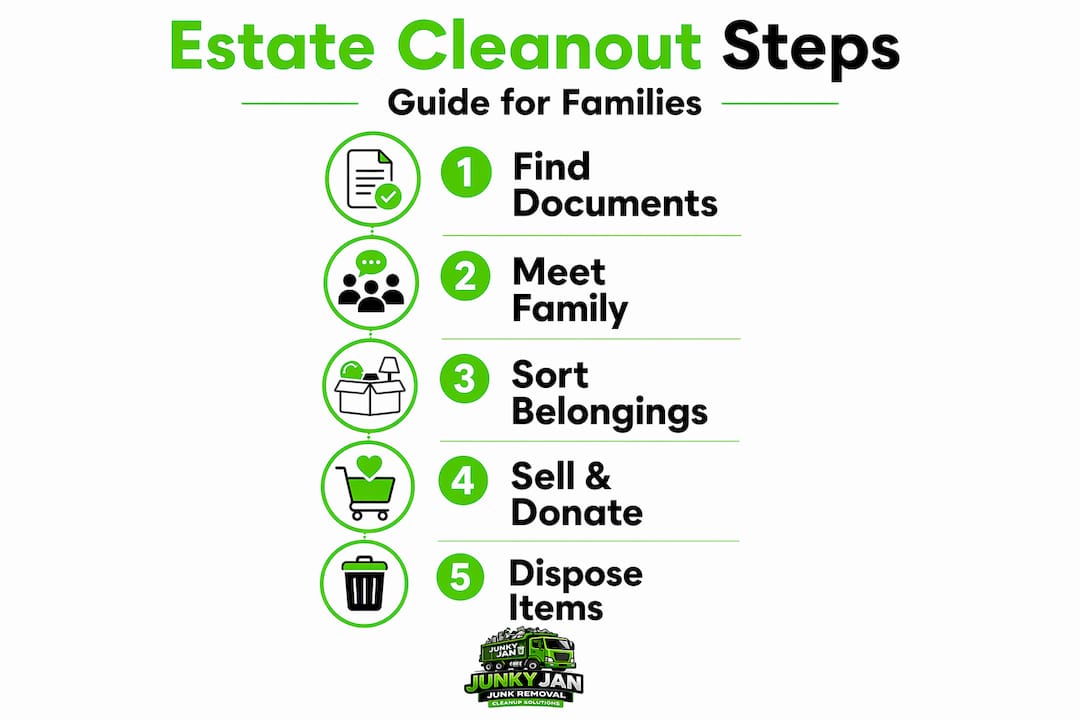
- Complete an initial walkthrough with your inventory list. Walk every room and note what's there. Flag anything that looks valuable or legally relevant. Photograph high-value items immediately.
- Sort belongings into four categories. Keep, sell, donate, and discard. Use your color-coded labels and apply them to every item before anything leaves the room.
- Handle sentimental items first, as a family. Gather the family and let each person request specific keepsakes before any selling or donating happens. Put agreements in writing to prevent disputes.
- Sell high-value items before donating or disposing. High-value items require professional appraisal and documentation for accurate probate accounting. Antiques, jewelry, art, and collectibles can be far more valuable than they appear.
- Choose your selling method based on what you have. According to liquidation experts, no single method works best for every estate. A combination of auction, estate sales, and online marketplaces typically produces the best results.
- Donate secondary items to local charities or thrift organizations. Many organizations will pick up furniture and household goods directly from the property, saving you trips.
- Dispose of remaining junk using dumpster rental or junk removal services. Dumpster rentals and professional hauling are the most practical solutions for bulky items and debris that cannot be sold or donated.
Pro Tip: Follow this order every time: sell first, donate second, dispose last. Selling high-value items first and disposing of junk last maximizes estate value and minimizes your removal costs.
Here is a comparison of the most common professional service options for managing estate debris:
| Service type | Average cost | Best for | Drawback |
|---|---|---|---|
| Dumpster rental | $300 to $600/week | Large volumes of mixed debris | You do all the loading |
| Junk removal company | $200 to $800 per load | Fast, full-service removal | Costs more than DIY |
| Estate clearing services | $1,000 to $5,000 total | Full-property post-death cleanup | Higher upfront investment |
| Donation pickup | Free | Furniture and household goods | Limited to sellable items only |
If you're managing estate cleanup in South Florida and need to understand exactly what a removal crew will take off your hands, the guide on what junk removal takes breaks it down clearly.
Common challenges during estate cleanout and how to handle them
Even the most organized estate cleanout runs into friction. Knowing what to expect keeps you from being blindsided when something goes sideways.
- Emotional overwhelm. Grief hits hardest when you're holding someone's belongings. Working in short sessions with scheduled breaks is not a sign of weakness. It is the approach experts consistently recommend to prevent burnout.
- Family disagreements. When relatives can't agree on who gets what, the executor has the legal authority to make final decisions within probate rules. Document all distributions in writing and keep copies.
- Unexpected discoveries. Hidden cash, unknown accounts, old legal documents, and uncatalogued valuables show up in almost every estate. Do not discard anything without reviewing it first.
- Safety hazards. Older homes may contain mold, asbestos, or rodent activity that surfaces during a cleanout. Wear protective gear and stop work immediately if you find anything that looks like a serious hazard.
- Documentation gaps. If items are distributed or sold without proper records, it can create probate complications. Every transaction, however small, should be logged.
"Taking time to understand the property and its belongings deeply before starting prevents later stress and mistakes. The more you know before you begin, the fewer regrets you'll have along the way."
Pro Tip: If you're dealing with significant family conflict over the estate, consider hiring a professional estate organizer or mediator before the cleanout begins. This small investment often saves thousands in legal fees and months of family tension.
Final steps before handing over the estate
Once the sorting and removal are complete, there's a final checklist before you can close the estate. Skipping these steps can create legal or financial problems down the road.
- Conduct a final walkthrough and verify your inventory. Compare what was removed or sold against your original list. Confirm that all items slated for distribution have been delivered to their recipients.
- Document all distributions and sales for probate. Executors must maintain thorough records of every sale, donation, and distribution to meet legal requirements and avoid future disputes.
- Arrange professional cleaning if needed. A move-out level cleaning improves the property's presentation for sale or transfer and may be required by an estate attorney or real estate agent.
- Secure the property. Change the locks, notify the homeowner's insurance company of the change in occupancy, and confirm utility accounts are transferred or canceled.
- Organize and close estate financial accounts. Work with the estate attorney to settle any outstanding bills, collect sale proceeds, and formally close accounts. File any final paperwork required by the probate court.
If the estate includes a garage packed with tools, equipment, or debris, a garage cleanout checklist can help you tackle that space without missing anything.
What I've learned from watching families do this
I've seen people approach estate cleanouts the way they approach a home renovation: with a hard deadline, a full crew, and the expectation that sheer effort will get it done fast. It almost never works that way. The physical labor is secondary to the emotional weight, and pushing too hard too fast leads to decisions people genuinely regret, things discarded that mattered, items given away in the heat of the moment, keepsakes lost because there wasn't time to look carefully.
What actually works is giving yourself permission to go slowly. Not indefinitely. But deliberately. A well-paced cleanout with clear daily goals gets done just as quickly as a chaotic marathon effort, with far fewer mistakes and far less emotional damage.
I also want to say something about professional help that most people hesitate to consider. Hiring an estate clearing service or a junk removal team is not abandoning your responsibility to the person who died. It is a practical decision that lets you focus your energy on the things only you can do: choosing what to keep, honoring memories, being present with your family. The physical hauling can be done by someone else. The grief is yours to carry, and you should not add unnecessary physical strain to it.
Finally, if you find yourself frozen and unable to start, that is normal. Pick one drawer. Not a room. One drawer. That's enough for the first day.
— gam
Let Junky Jan help with the heavy lifting

When you're ready to remove furniture, appliances, and debris from an estate in Miami, Hollywood FL, or Broward County, Junky Jan is ready to help the same day. Managing a post-death estate cleanup is already demanding. The last thing you need is to haul a sofa to the curb yourself or rent a dumpster and load it alone. Junky Jan's licensed and insured crews handle the heavy items, the bulk debris, and the full-property removal so you can focus on what matters. Pricing is based on load size with no hidden fees, and scheduling is flexible around your timeline. Get started with same-day junk removal in Miami and Broward County today.
FAQ
How long does an estate cleanout after death take?
A typical estate cleanout for an average-sized home takes between 3 and 6 weeks. Larger or more complex estates can take 2 to 3 months depending on the volume of belongings and the number of people involved.
What do I do first when cleaning out a deceased person's estate?
Start by locating the will, financial documents, and insurance policies before moving or removing anything. Knowing who has legal authority over the estate prevents costly mistakes and family conflict from the start.
How much does a professional estate cleanout cost?
Professional estate cleanout services typically cost between $1,000 and $5,000 depending on property size and complexity. These costs can usually be reimbursed directly from the estate if receipts are kept.
What is the best way to sell estate belongings?
Combining multiple selling methods including auctions, estate sales, and online marketplaces produces the best results. Sell high-value appraised items first, then donate secondary goods, and use junk removal services for anything unsellable.
How do I handle family disputes during an estate cleanout?
The executor or administrator has legal authority to make final decisions on estate assets, even when family members disagree. Putting all agreements and distributions in writing from the beginning is the most effective way to reduce conflict.