
Most people assume getting rid of a couch or a broken dresser is simple. You drag it to the curb and it disappears. In reality, understanding how bulk furniture removal works involves scheduling windows, item restrictions, placement rules, and pricing tiers that catch most homeowners and renters completely off guard. This guide breaks down the full furniture removal process, from municipal bulk pickup programs to private bulk junk removal services, so you know exactly what to expect before your next cleanout.
Table of Contents
- Key takeaways
- How bulk furniture removal works through city programs
- How private bulk junk removal services operate
- Preparing your furniture for a smooth pickup
- Environmental considerations in bulk furniture disposal
- Municipal vs. private removal: comparing your options
- My honest take on navigating bulk furniture removal
- Get your furniture removed the easy way with Junky Jan
- FAQ
Key takeaways
| Point | Details |
|---|---|
| Schedule early | Most municipal programs require at least 2 business days' notice before collection day. |
| Know your item limits | Cities like Saint Paul cap pickups at one bulky item per month, with fees for extras. |
| Prepare items correctly | Refrigerators and mattresses need special prep or they will be rejected at pickup. |
| Private services cost more but offer flexibility | Expect to pay $150 to $350 for standard loads, with add-on fees for stairs or tight access. |
| Eco-friendly options exist | Donating, recycling, or using a hauler with disposal partnerships reduces landfill impact. |
How bulk furniture removal works through city programs
Municipal bulk furniture pickup is the most misunderstood option most homeowners have. City programs are real, useful, and often free within limits. But they come with rules that, if ignored, will leave your sofa sitting on the curb untouched.
What qualifies as a bulk item? Most cities define it as anything too large for a standard garbage bin: sofas, bed frames, dressers, tables, chairs, and some appliances. The definition varies by city, so checking your local public works website before scheduling is non-negotiable.
Scheduling and timing rules
Municipal bulk pickups typically require scheduling at least two business days before collection, and items set out without a confirmed appointment may simply be skipped. This catches a surprising number of people off guard, especially those who assume bulk pickup works like regular trash service.
Curbside placement timing is just as strict as the scheduling requirement. Providence, for example, requires items placed no earlier than 4 PM the day before and no later than 4 AM on collection day. Put your furniture out too early, and a neighbor might call it a code violation. Put it out too late, and the truck is already gone.
Item quantity and size limits
Cities also cap how much you can set out. Saint Paul allows one bulky item per unit per month, and any additional items cost $30 each plus tax. Fairfax County limits special pickups to 2 cubic yards and items under 6 feet in length, charging extra for anything that exceeds those dimensions. If you are clearing out a whole room, these caps can make municipal service impractical on its own.
Pro Tip: Before scheduling a municipal pickup, photograph everything you plan to set out and check your city's restricted items list. A single prohibited piece mixed in with accepted items can cause the entire pickup to be rejected.
How private bulk junk removal services operate
Private bulk junk removal services work very differently from city programs. The trade-off is straightforward: you pay more, but the service bends to your schedule and takes almost anything.
Here is what the typical private furniture removal process looks like from start to finish:
- Request a quote. Most companies offer free estimates online or over the phone. Some will send a crew to assess in person before quoting, especially for large clearouts.
- Schedule your appointment. Unlike municipal programs that run on fixed weekly routes, private services frequently offer same-day or next-day availability. This matters when you are on a moving deadline.
- Prepare your items. Furniture should be staged with clear access. Unclear staging or blocked items can lead to delays or extra labor charges when the crew arrives and has to re-sort.
- The crew loads and hauls. A licensed team handles all the heavy lifting, including navigating stairs and tight hallways. You point, they lift.
- Pay based on volume. Pricing is calculated by how much of the truck your load fills, not by the hour.
Understanding the cost of bulk furniture removal
Private services charge $150 to $350 for standard loads, with minimum fees ranging from $70 to $120 for small jobs. Stair flights add $50 to $125 each, which is worth knowing before you call. An elevator building in Miami and a fourth-floor walkup in a Broward apartment complex are priced differently for a reason.
Understanding Miami junk removal costs is especially useful if you are in South Florida, where demand, access conditions, and item types all influence the final price.
Pro Tip: Ask every private hauler upfront whether their quote is all-inclusive. Some companies add fuel surcharges, disposal fees, or minimum charges that nearly double a seemingly low estimate.
Preparing your furniture for a smooth pickup
Preparation is where most bulk furniture pickups fail. Whether you are using a city program or a private hauler, a few common mistakes will cost you time, money, or a missed pickup.
Here is what to handle before your scheduled removal day:
- Empty and clean all items. Food left in refrigerators or freezers is one of the most common rejection triggers. Boston's public works department requires fridge doors removed and all food cleared before any pickup will occur.
- Bag mattresses properly. Providence requires mattresses bagged in clear, sealed plastic bags before collection. An unbagged mattress, especially one showing signs of infestation, is a hard reject and will not be collected under any standard program.
- Separate prohibited items. Hazardous materials like paint, chemicals, and batteries cannot go with bulk furniture. Mixing them with your pile will get the whole load refused.
- Stage with clear access. Leave at least three feet of clearance around each piece. Blocked items cause skipped pickups because routes are optimized and crews will not reroute or wait.
- Label items for private haulers. If you have items you want kept versus items to be removed, use colored tape or notes. This prevents accidental removal of things you meant to keep.
Renters face an added layer of complexity here. Renters in multi-unit buildings often cannot schedule city pickups independently and must coordinate with property managers, who may have building-specific rules about staging locations and approved haulers.
Pro Tip: If you are preparing for a private pickup, do the staging work the morning of your appointment rather than the night before. This keeps items dry, reduces theft risk, and keeps neighbors and building management from filing complaints.
Environmental considerations in bulk furniture disposal
Not every piece of furniture needs to go to a landfill. That is an easy default, but it is rarely the best option, either for the environment or for your community.
Items in good structural condition but worn cosmetically, such as a dated couch with solid frames or a scratched wood dresser, are strong candidates for donation. Organizations like Habitat for Humanity ReStores accept furniture and resell it to fund affordable housing projects. Many will pick up directly from your home at no charge.
Restricted and hazardous materials to know
- CRT televisions and monitors (contain lead)
- Refrigerants in older appliances (require certified handling)
- Asbestos-containing materials in pre-1980 furniture (requires specialized removal)
- Pressurized canisters or aerosol containers
- Any item showing active pest infestation, particularly bed bugs
Infested furniture, especially mattresses, is treated as a hard reject across nearly every municipal and private program. It requires specialized disposal outside standard bulk pickup channels, often through pest control operators or licensed bio-hazard haulers.
Choosing to donate, recycle, or use a hauler with verified disposal partnerships is the single most effective choice you can make to keep furniture out of already-strained landfills.
Private haulers with responsible disposal practices will sort your items on arrival, directing reusable pieces toward donation centers, recyclable materials toward processing facilities, and only true waste to the landfill. Ask your hauler explicitly about their disposal chain before booking.
Municipal vs. private removal: comparing your options

Making the right call between city pickup and a private service comes down to four factors: cost, speed, item type, and your specific living situation.
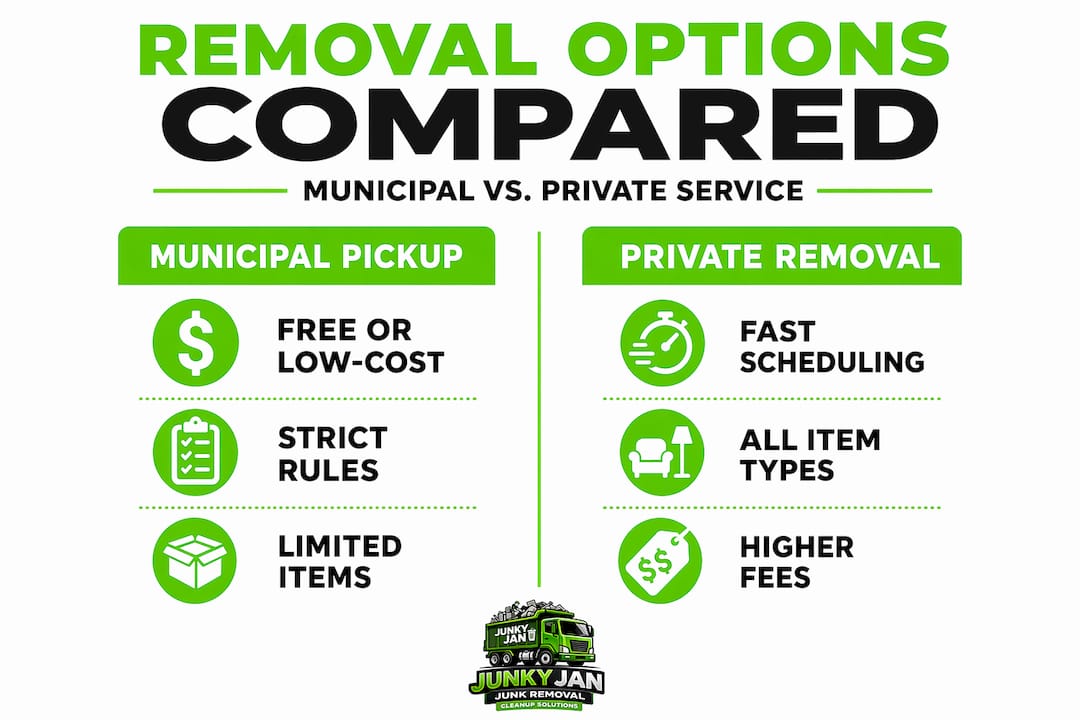
| Feature | Municipal bulk pickup | Private bulk junk removal |
|---|---|---|
| Cost | Free to low-cost (fees for extras) | $150 to $350+ based on load size |
| Scheduling | 2+ business days advance notice | Same-day or next-day often available |
| Item limits | Yes (volume, dimensions, monthly cap) | Minimal restrictions |
| Special item handling | Restricted (appliances, mattresses need prep) | Most items accepted with proper prep |
| Best for | Single items, homeowners with time | Renters, large clearouts, urgent moves |
| Access considerations | Curbside only | In-home pickup available |
Homeowners with a single couch to dispose of and a flexible timeline are ideal candidates for the municipal route. Renters on a tight moving schedule or anyone clearing multiple rooms will almost always find private bulk junk removal services faster, less stressful, and worth the cost.
The furniture removal process through a private service is also significantly more predictable. You book, they show up, it is done. There is no waiting to see if the truck catches your window.
Pro Tip: If you are comparing local providers, ask whether they are licensed and insured before the crew arrives. An unlicensed hauler who damages your property or illegally dumps your items can leave you holding the liability.
My honest take on navigating bulk furniture removal
I have seen a pattern repeat itself constantly: people schedule a municipal pickup, miss a rule they did not know existed, and end up with furniture sitting on the curb for a week. The system works, but it rewards the people who read the fine print.
My honest advice? If you have a single, non-restricted item and at least five days before you need it gone, the city program is absolutely worth using. But if you are a renter dealing with building management approvals, working around a moving deadline, or clearing more than two or three pieces, private removal is the smarter move financially when you factor in the value of your time and the risk of a rejected pickup.
The sustainability angle also matters more than most people realize. I would always ask a private hauler where your items actually end up. A hauler who can tell you their specific donation and recycling partners is one worth paying a bit more for.
Plan early, know your items, and do not underestimate the prep work. That combination solves about 90% of the problems people run into.
— gam
Get your furniture removed the easy way with Junky Jan
If you are in Miami, Hollywood, or Broward County and need fast, no-hassle bulk furniture removal, Junky Jan makes the entire process straightforward.

Junky Jan's licensed and insured crews offer same-day and next-day scheduling with transparent, volume-based pricing and no hidden fees. From a single recliner to a full room clearout, the team handles all the heavy lifting and responsible disposal, so you never have to wonder where your items end up. Whether you are a homeowner in the middle of a renovation or a renter on a tight move-out timeline, same-day junk pickup in Miami is a call away. Get a free quote and book in minutes.
FAQ
What is bulk furniture removal?
Bulk furniture removal is the collection and disposal of large household items that do not fit in standard trash bins, including sofas, mattresses, dressers, and appliances. It can be handled through municipal programs or private junk removal services.
How far in advance do I need to schedule a bulk pickup?
Most municipal programs require at least two business days' advance notice, and items placed without a confirmed appointment may not be collected at all.
How much does bulk furniture removal cost?
Private bulk furniture removal typically costs between $150 and $350 for standard loads, with minimum fees of $70 to $120 for smaller jobs and additional charges of $50 to $125 per stair flight.
Can I put out any furniture for bulk pickup?
No. Most programs restrict infested items, hazardous materials, and oversized pieces. Mattresses often require sealed plastic bags and refrigerators must have doors removed and food cleared before collection.
Is private junk removal better than municipal pickup?
It depends on your situation. Municipal pickup is free or low cost but comes with scheduling and quantity limits. Private bulk junk removal services are faster, accept more item types, and offer in-home pickup, making them the better choice for large clearouts or time-sensitive moves.