
If you manage more than two properties, you already know that what is multi-property junk hauling is not a simple question with a simple answer. It is not just booking a truck and hauling stuff away. Property managers and real estate investors who treat it that way end up with missed pickups, delayed turnovers, hidden fees, and compliance headaches they never saw coming. This guide breaks down how multi-property junk removal actually works, what the logistics look like behind the scenes, and exactly what to do so it stops being a problem in your portfolio.
Table of Contents
- Key takeaways
- What multi-property junk hauling actually means
- The logistics and technology behind multi-property operations
- Compliance and insurance for multi-property hauling
- Benefits of multi-property junk hauling done right
- How to implement multi-property junk hauling effectively
- My take on what actually makes or breaks this
- Junky Jan makes multi-property hauling simple
- FAQ
Key takeaways
| Point | Details |
|---|---|
| More than one truck, one stop | Multi-property hauling requires coordinated crews, route planning, and real-time dispatch across multiple addresses. |
| Access friction costs you money | Locked doors, stairs, and missing parking instructions delay crews far more than item volume does. |
| Compliance varies by city | Private hauling regulations and disposal rules differ by jurisdiction, so verifying a hauler's authorization protects you from liability. |
| Costs scale with load and labor | Pricing runs from $60 for small loads up to $800 for full truckloads, and multi-stop jobs require structured cost planning. |
| Scope cards cut schedule slips | Preparing detailed job notes per unit before crews arrive prevents mid-route delays and capacity overflows. |
What multi-property junk hauling actually means
The industry term for this service is portfolio junk removal or commercial junk removal services, and it describes the organized removal of unwanted items across two or more properties in a coordinated, often scheduled operation. The phrase "multi-property junk hauling" has become the practical shorthand that property managers and investors use when they need more than a one-off residential pickup.
So what is junk hauling at the single-property level? You call a crew, they show up, they take your stuff. That works fine for a homeowner with an old couch. It falls apart when you are managing a 12-unit apartment building with three vacant units, or a portfolio of rental homes scattered across two zip codes, all turning over in the same week.
Multi-property junk removal expands the scope significantly. Here is what a typical job actually involves:
- Scheduling across multiple addresses on overlapping or back-to-back timelines without creating crew conflicts
- Coordinating access at each property, including tenant schedules, lockbox codes, and parking logistics
- Sorting items by disposal type at each stop, since what can be donated, recycled, or landfilled differs by city and item condition
- Managing truck capacity across a route so a crew does not fill their truck at stop two and abandon stops three and four
- Tracking job completion in real time so you know exactly which units are cleared and which are still pending
The difference between single-property hauling and multi-site removal is not just volume. It is the operational layer that has to exist on top of the physical work.
The logistics and technology behind multi-property operations
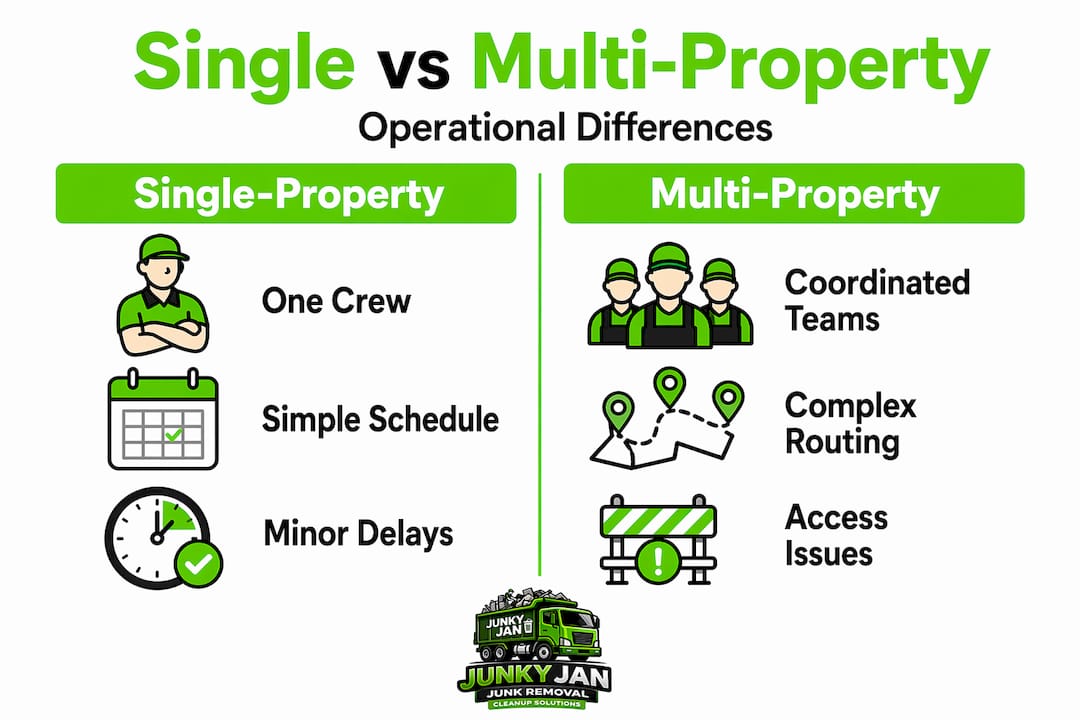
This is where most property managers are surprised. The physical act of lifting and hauling is the easy part. The hard part is the coordination that has to happen before the first truck leaves the yard.
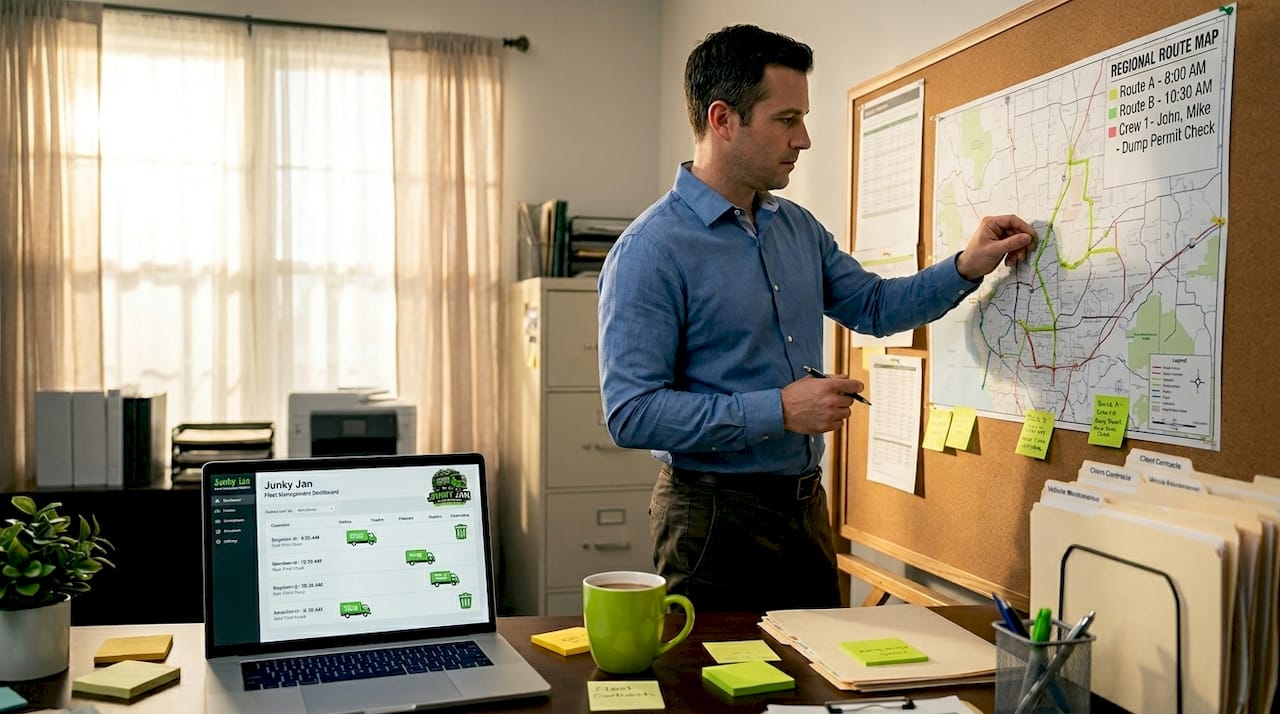
Multi-truck coordination and giving crews full visibility of every job on their route prevents missed jobs and reduces dispatcher calls mid-route. Without that visibility, you get crews calling in for directions, waiting outside locked units, or making judgment calls about what to take that they should never have to make on their own.
Modern junk removal software handles scheduling, real-time crew tracking, job reassignment, and scalable workflows for multi-truck and multi-day jobs. Dispatchers can see all job addresses, access details, and job order to reduce missed jobs and downtime. This matters for you as a property manager because it directly affects whether your turnover timeline holds or slips by two or three days.
Pro Tip: Ask any hauling service you are considering whether their dispatcher has real-time visibility into all active jobs on a route. If the answer is "we use phone calls," that is a red flag for multi-stop work.
Access friction is the underestimated bottleneck in portfolio junk removal. Standardized access notes with parking, stair counts, door sizes, and junk location eliminate idle waiting and keep multi-property schedules on track. When a crew shows up and cannot get into a unit, that stop often gets skipped entirely, pushing everything in your turnover calendar back.
| Logistics Factor | Single-Property Impact | Multi-Property Impact |
|---|---|---|
| Access friction | Minor delay at one stop | Cascading delays across all stops |
| Truck capacity | One load calculation | Route-wide capacity planning needed |
| Disposal sorting | One destination | Multiple destinations per route |
| Scheduling | One appointment | Coordinated windows across addresses |
| Communication | Owner to crew | Dispatcher, crew, and multiple contacts |
Platforms that specialize in home services now incorporate AI-assisted route planning for exactly this kind of multi-stop challenge, reducing drive time and idle gaps between jobs significantly.
Compliance and insurance for multi-property hauling
This section often gets skipped, and that is where property managers get burned. Local private hauling regulations are not uniform. They vary by city, county, and sometimes by the type of waste being removed.
Local private hauling regulations can require specific authorization or even franchise agreements for private junk removal companies handling solid waste. That means a hauler who operates legally in one municipality may not be authorized to pick up in the neighboring city. When you hire a service for a multi-city portfolio, this is not a theoretical concern. It is a real compliance risk.
Here is what to verify before signing any multi-property agreement with a hauler:
- Business license and local operating permits in each city where your properties are located
- General liability insurance with a certificate you can hold on file, covering property damage and crew injuries on-site
- Disposal authorization for the specific waste types at your properties, including electronics, appliances, construction debris, and hazardous materials
- Waste manifest documentation for any regulated materials, so you have a paper trail if a compliance question ever arises
Hiring an uninsured or unauthorized hauler to clear out a rental property puts you, not the hauler, in the liability seat if something goes wrong on-site or at the disposal facility. Always request proof of insurance and authorization before work begins.
The difference between reputable commercial junk removal services and cut-rate operators usually shows up in exactly this documentation. Professional crews carry it. Fly-by-night operations often cannot produce it.
Benefits of multi-property junk hauling done right
When multi-property junk removal is executed well, the benefits go well beyond a clean unit. They directly affect your revenue as a property manager or investor.
Faster property turnover is the most immediate payoff. Same-day and next-day service from professional crews improves property market readiness, cutting days of vacancy that cost you rental income. A single day of vacancy on a $2,000-per-month unit costs roughly $67. Multiply that across a portfolio of ten properties with average two-day delays per turnover, and you are looking at over $1,300 in lost revenue per cycle that an efficient hauling operation would eliminate.
Cost savings compound with consolidation. Junk removal pricing is typically tiered by load size: small loads run $60 to $150, half truckloads run $200 to $400, and full truckloads run $600 to $800. When you route multiple properties on the same dispatch day, you spread fixed costs like drive time and disposal fees across more stops. That lowers your per-unit cost noticeably.
Pro Tip: Negotiate a rate structure with your hauling provider based on monthly volume rather than per-job pricing. Once you hit a predictable cadence of cleanouts, this saves 15 to 20 percent compared to booking individual jobs.
Tenant satisfaction also improves when turnover happens quickly and cleanly. A unit that is cleared, cleaned, and ready to show within 48 hours of vacancy signals professionalism to incoming tenants. That first impression affects lease signing rates more than most investors account for.
| Metric | Reactive Hauling | Coordinated Multi-Property Hauling |
|---|---|---|
| Average days to clear a unit | 4 to 6 days | 1 to 2 days |
| Cost per unit cleanout | $350 to $600 | $180 to $350 with consolidated routing |
| Compliance documentation | Often missing | Verified before work begins |
| Vacancy loss per delayed day | $50 to $100+ | Minimized with scheduled windows |
How to implement multi-property junk hauling effectively
Getting this right is mostly about preparation and the right questions asked before anyone shows up at your properties.
-
Create a scope card for every unit. Each card should list item types, approximate volume, access instructions, and any special handling flags like appliances that need refrigerant removal or electronics that require certified disposal. Treating each unit as a scope card with flags for special handling and capacity requirements prevents mid-route capacity overflows and schedule delays.
-
Standardize your access information. Every property should have a consistent format: lockbox code or key contact, parking instructions, stair count, and unit number. Providing detailed access information to crews before dispatch eliminates idle time at the curb and keeps the route on schedule.
-
Ask providers the right questions. Specifically: Do they dispatch with real-time job visibility? Do they handle multi-stop routes regularly? Can they provide certificates of insurance for each city in your portfolio? What is their process for capacity overflows mid-route?
-
Schedule during low-friction windows. Mid-morning slots on weekdays minimize parking competition and elevator conflicts in multifamily buildings. Avoid scheduling multiple stops too close to each other geographically if access times vary widely.
-
Use technology to track job status. Even basic confirmation texts or email updates per completed stop give you the oversight you need without calling the dispatcher every hour.
Pro Tip: Build a simple spreadsheet template for your scope cards that you duplicate per turnover cycle. Sharing this with your hauler before the route is built saves significant back-and-forth on job day.
My take on what actually makes or breaks this
I have seen property managers spend thousands on the wrong approach before finally getting multi-property junk removal right. What I have learned is that the physical hauling is almost never the problem. The problem is almost always the handoff between information and execution.
When a crew shows up without knowing that unit 4B has a piano and a locked secondary door, the whole schedule falls apart. Not because the crew cannot handle it. Because nobody told them in time to plan for it. The scope card discipline I described above sounds administrative and boring. In practice, it is the single biggest difference between a portfolio that turns over on schedule and one that consistently runs three days behind.
Access friction affects turnaround speed more than item volume alone. I have seen a two-bedroom unit with minimal furniture take twice as long to clear as a packed three-bedroom simply because of a parking situation that added 40 minutes per trip. That kind of invisible time loss adds up across a portfolio faster than most investors expect.
The other thing I would push back on is the instinct to always choose the cheapest hauler. The cost difference between a $200 per job budget operator and a $280 per job professional service often disappears the first time a budget crew misses a stop, skips a compliance step, or damages something during removal. Investing in coordination technology and proper authorization documentation is not overhead. It is protection.
— gam
Junky Jan makes multi-property hauling simple
If your properties are in Miami, Hollywood, or anywhere in Broward County, Junky Jan is built for exactly the kind of work this article describes. The crews are licensed, insured, and experienced in portfolio-scale cleanouts across multiple property types, from single-family rentals to apartment buildings.
Whether you need a same-day cleanout on a freshly vacated unit or want to schedule a recurring clearing cycle across your full portfolio, Junky Jan handles the logistics so you do not have to. Flexible scheduling, transparent load-based pricing with no hidden fees, and crews who show up prepared with your property details already in hand. If you manage multiple properties in South Florida, schedule your junk pickup with Junky Jan today and see what a coordinated hauling operation actually looks like.
FAQ
What is multi-property junk hauling?
Multi-property junk hauling is the coordinated removal of unwanted items across two or more properties in a single scheduled operation, requiring route planning, crew dispatch, and compliance management across all locations.
How much does multi-property junk removal cost?
Costs range from $60 to $800 per stop depending on load size and access difficulty, but consolidated routing across multiple properties on one dispatch day typically reduces the per-unit cost by 15 to 30 percent.
What should I ask before hiring junk haulers for multiple properties?
Ask whether they carry liability insurance, have operating authorization in each city, use real-time dispatch software, and have experience managing multi-stop routes with scope cards and access notes per property.
Why does access friction matter so much in portfolio hauling?
Access issues like stairs, locked doors, and parking constraints slow crews down more than item volume does, creating cascading delays across every stop on a multi-property route.
How do I prepare my properties for a multi-stop junk removal job?
Create a scope card for each unit listing item types, access codes, stair counts, and any special handling requirements, then share all of it with your hauler before the route is built, not on the day of the job.